December 19, 2025
Affiliate Disclosure: This article contains affiliate links. If you purchase through these links, I may earn a small commission at no extra cost to you. I only recommend products I use or would use on my own farm. Read my full disclosure policy.
When I told people I was planting 100+ loblolly x pitch pine hybrids in Missouri for pine straw production, the response was – isn’t pine straw a Southeast thing?
Well, yes. But, annual pine straw yields can generate $300 to over $1,200 per acre depending on species, age, and management intensity. That’s real money for land that’s otherwise sitting idle in our case. The question is whether these hybrid pines can produce that kind of income this far north—and what it’ll actually take to get there.
Why Pine Straw?
We visited the University of Missouri – Horticulture and Agroforestry Research Center back in the mid 2010’s, and saw a planting of the hybrid pines. After reading a few very helpful publications, such as the UMCA® – Agroforestry Technical Briefs – Pine Straw Production, and USDA Agroforestry Center – Pine Straw – a profitable agroforestry enterprise, we saw the benefits of pine straw. These include: cheaper per square foot than hardwood mulch, better moisture retention and weed suppression, long lasting, and better for soil nutrient balance than hardwood chips.
We figured the pine straw would be an economical way to mulch all of our new tree plantings, and if any was left over to sell, well that would be icing on the cake.
Why These Particular Pines?
The UM Horticulture and Agroforestry Research Center in mid-Missouri has a small planting that is mature, and producing pine straw bales. The loblolly x pitch pine hybrid caught my attention because it’s supposed to combine the best of both parents. The cross brings together pitch pine’s cold tolerance and drought resistance with loblolly’s faster growth and better form. Since pure loblolly isn’t reliably hardy in Missouri winters, the hybrid seemed like the logical choice.
The Missouri Department of Conservation sells these hybrids in their tree seedling program, which gave me some confidence this wasn’t a completely harebrained idea. If MDC is selling them, at least I’m not the first person in the state to try it.
The 12×12 Offset Grid Decision
We planted ours on a 12-foot by 12-foot offset grid. Let me walk through that math because it matters for anyone considering this.
On a square 12×12 grid, you’d get about 302 trees per acre (43,560 square feet ÷ 144 square feet per tree). With offset rows—where every other row is staggered—you still end up with roughly the same density but better light distribution and potentially better needle production down the line. The offset pattern also gives you slightly more flexibility for equipment access if you need to mow or spray (turns at the end of every other row).
Why 12 feet? Well, that’s what was cited as the suggested spacing in the UMCA Pine Straw Production publication. That initial spacing should start providing some shading of the grassy rows soon. The plan is to thin to 12×24 at 6-10 years, so 2027-2031 for us. Then another thinning to 24×24 at 10-15 years. With the competition from grasses in early growth years in our situation, we’re likely looking at the tail end of these windows for thinning.
What One Hundred and Fifty Trees Actually Costs
Let’s talk real numbers.
The seedlings themselves ran about $0.28 each through the state program – in 2021. So we bought 25 for $7. Shipping was another $8.
In 2022, we bought another 25 for $9, plus $9 shipping.
In 2023, we didn’t buy any, just cleared more space in the planting area.
In 2024, we bought 100 for $34, plus $24 for shipping. The extra seedlings were needed as some died.
Then you need fencing. The first two years, we just had wire cages around each tree. Then in year three, we built what is typically called a “3-D fence” around the perimeter—basically a combination of woven wire and electric strands meant to keep deer out. Materials for fencing about an acre (my planting is roughly 0.4 acres with the trees, but I fenced more) ran about $175 for the charger and wire, and another $200 for t-posts and short posts for the outside strand.
Spoiler: the deer don’t care too much about the 3-D fence. They’ve browsed a few trees already. Not devastation, but enough to make me wonder if I should’ve just caged each individual tree and called it a day, which we may end up doing in the future. I do think they would rather not jump through the fence and just browse somewhere else, but I have seen a few fawns just standing around in there as I drove up.
For site prep, I mowed the area and used weed barriers around each seedling. As with all seedlings that we plant, grass competition is fierce in the open sunlight. I used a measuring tape reel to mark planting locations on 12×12 grid.
Planting itself was three people, three shovels, and about six hours of back-bending work. If you hire this out, figure another $200-300 for labor at scale.
So we’re looking at roughly $600-700 all-in for 150 trees on about half an acre. Scale that up to a full acre of 300 trees at 12×12 spacing, and you’re probably around $1,200-1,600 depending on how much labor you’re willing to contribute.
What Happened:
Here’s what I learned the first season: many of the 25 trees survived and grew. Also, I knew there was going to be a fierce battle with the grass in the area, especially in July/August when the heat/humidity and lack of rainfall hit hardest in our area.
In the second year, two of the taller trees were destroyed by deer rubs – the wire cages were just tossed aside. A few of the others didn’t make it through dry period in the summer.
The third year was spent clearing more overgrowth out.
The fourth year, we planted the next 100, and installed the 3-D fence. In spring/summer 2025, we had a very wet May-July, leading to great growing conditions for seedlings – then a several month drought in late summer. But it seems most seedlings survived.
Row of pines – December 2025
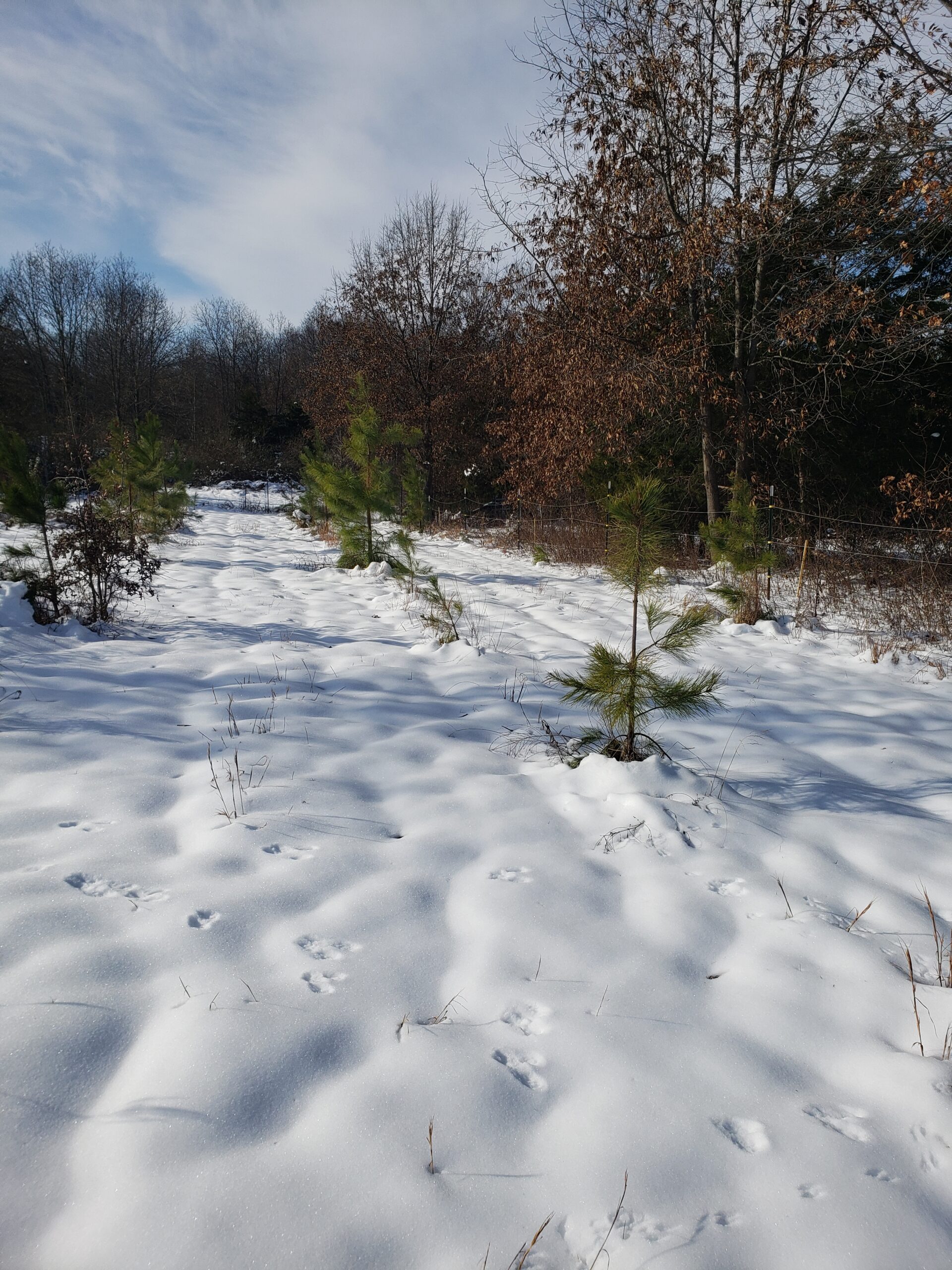
Some of our trees doubled in height within the third growing year, and I saw that on maybe 25% of our trees. The classic “sleep-creep-leap” growth pattern. The other trees grew more conservatively. That’s probably normal for the first couple years after establishment.
The grass problem: Grass competition is brutal. The 3-D fence didn’t mean I couldn’t mow close to the trees, but all around the fence, and around each and every seedling, the grass was thriving by mid-summer. I ended up spot-spraying the weed mats around individual trees, and pulling grass near the seedlings themselves. It was tedious, hot work, and I still didn’t win completely. In 2025, the plentiful rainfall in June through July probably saved several seedlings.
Pine straw operations need clean understory conditions to rake efficiently, so this grass battle is going to continue for years, probably until the trees get tall enough to get some shade over the rows and suppress the grass.
The deer situation: Despite my fancy fence, deer have tested a few trees so far. Most of the damage is just browsing on the tender new growth, not necessarily killing the tree. But a few trees got hit hard enough that growth stalled or killed the tree. I may need to add individual wire cages if this continues. Hopefully this winter, bucks will rub on other less valuable young trees, like autumn olive! Adding pain to the situation is that bucks won’t rub on very young trees, they target ones that are 5-8ft tall, with 1 or 2 inch diameter trunks. These are the very trees that are set to grow well the next year – just to be destroyed if rubbed in late autumn.
The electric fence and grass combo: Here’s a problem I didn’t anticipate: the grass grows so aggressively near the electric fence that it cuts the charge regularly. If I don’t spray the fenceline, I’m out there every two weeks whacking grass away from the wires. It’s a pain. If I did this 3-D fence again, I might use weed barrier material under the outer wire.
What I’m Not Seeing Yet (But Hope To)
Pine straw production doesn’t really start until year 7-8 at the earliest. Young stands begin producing 100-150 bales per acre around age 7-10, with peak production of 150-300 bales per acre around age 15. These harvests are every other year, not every year.
At a starting 12×12 spacing, my yields might land on the lower end of that range—call it 150-200 bales per acre at peak if everything goes right. I have no idea what hybrid needles will command price-wise, or if there’s even a market for them in Missouri. But, UMCA® sells out of their bales, and they were selling for around $5.50/20# bale back in 2016. There is also a producer in mid-MO who is selling 18-20# bales for $15.
If I can hit 100 bales per acre at $5 per bale (being conservative), that’s $500 per acre every other year once production starts. Not barn-burning money, but not nothing either—especially if these trees eventually have timber value as well.
I’m looking forward to the year, hopefully soon, when the trees are tall enough to start shading the grassy rows and the scales will tilt towards straw production, versus tedious weed suppression in the summer heat.
Fertilization
Once harvest begins, we will have to determine nutrient supplementation amounts, since removing the pine needles takes nitrogen away. The UMCA® Pine Straw publication gives a general recommendation of 175# of nitrogen, 50# elemental phosphorus, and 70# of potassium per acre, every five years. So for this ½ acre plot, we’re looking at half those amounts, every five years.
Lessons Four Years On
If you’re thinking about trying this, here’s what I’d tell you:
Plan for grass control. Don’t assume you can plant and walk away. Budget time or money for aggressive weed control in years 1-7. This might mean mowing, weed barriers, herbicides, or all of these. A good, thick weed barrier around each seedling will help.
Deer pressure is real. Either build a more effective 3-D fence (taller, perhaps with more electric strands), plan to protect individual trees with tubes or cages, or build a deer fence (8ft tall to be on the safe side). My compromise approach isn’t working as well as I hoped.
Start small. I’m glad I planted 150 trees instead of a larger plot. That let me learn the grass, deer, and spacing issues without betting the farm. If this works, I can expand. If it doesn’t, I’m out less than $700 and some pride.
Think long-term. These trees won’t produce income for 7-10 years minimum. That’s a long time to manage grass, watch for deer, and hope the market for Midwest pine straw actually materializes. It’s not a get-rich-quick scheme.
What’s Next
For the next few years, my priorities are:
- Better grass control early in the season before it gets away from me
- Either fixing the deer fence or adding individual tree protection
- Once trees begin to fill space, thin to 12×24 spacing
I’ll update this series in the future when I have a better sense of whether these hybrids can actually produce commercial quantities of pine straw in Zone 6. For now, all trees are alive, they’re growing, and I’m learning what it actually takes to establish a pine straw operation outside the traditional Southeast market.
Is it worth it? Ask me in 2032.
This is the fifth article in my agroforestry series. Previous articles covered various chestnut topics. All of these experiments share a common theme: testing whether non-traditional tree crops can generate profit on marginal Midwest farmland. Some will work, some won’t. The only way to find out is to plant, document, and share what actually happens.
University of Missouri Center for Agroforestry – Agroforestry Technical Brief – Pine Straw Production
USDA National Agroforestry Center – Agroforestry Notes – Pine Straw – A profitable agroforestry enterprise. AF Note-37. October 2011.
Affiliate Disclosure: This article contains affiliate links. If you purchase through these links, I may earn a small commission at no extra cost to you. I only recommend products I use or would use on my own farm. Read my full disclosure policy.